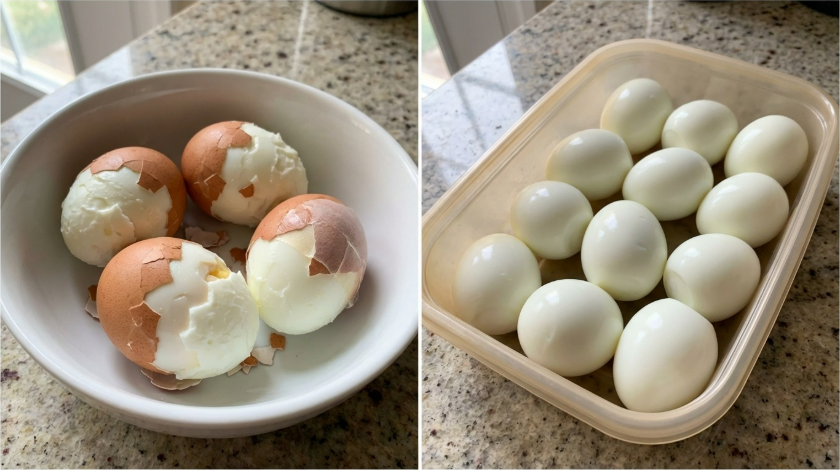
If you’ve ever struggled with a hard-boiled egg that refuses to peel cleanly—leaving behind a cratered, pockmarked mess—you’re definitely not alone. Fortunately, chefs and food scientists have cracked the code. The secret isn’t in how you peel the egg, but in how you cook and cool it.
Here’s the foolproof method professionals use to get smooth, pristine eggs every time.
The 3-Step Chef’s Method
1. Start with Older Eggs (Yes, Really!)
Why: Fresh eggs have a lower pH, which causes the egg white to cling tightly to the inner shell membrane.
Tip: Use eggs that are 7–10 days old. They peel far more easily than farm-fresh eggs.
2. Steam Instead of Boil (A Game-Changer!)
How to do it:
Add 1 inch of water to a pot and bring it to a boil.
Place the eggs in a steamer basket and cover.
Steam for:
Soft-boiled: 6 minutes
Medium: 8 minutes
Hard-boiled: 12–13 minutes
Why it works:
Continued on next page:
Steam cooks the eggs evenly and creates a thin air pocket between the egg white and the membrane, making peeling almost effortless.
No steamer? You can simmer eggs gently in boiling water, but avoid rapid boiling—it can toughen the whites and cause cracking.
3. Ice Bath + Shake Method (The Final Trick)
Immediately transfer the eggs to a bowl of ice water after cooking. Let them chill for at least 15 minutes. The cold causes the egg to contract, loosening the membrane.
To peel:
Gently tap the egg on the counter to crack the shell all over.
Roll it between your palms to loosen the shell.
Peel under water (or in a bowl of cold water). The water slips under the membrane and helps lift the shell away cleanly.
Pro Tip: Add 1 teaspoon of baking soda to the cooking water. It raises the egg’s pH, further weakening the bond between the egg white and the shell.
What Doesn’t Work (Despite the Myths)
Poking holes before cooking: Often leads to cracks and uneven cooking.
Adding vinegar to the water: Helps coagulate whites if the egg cracks, but doesn’t make peeling easier.
Peeling eggs while warm: The membrane sticks more when the egg is hot.
Why This Matters
Continued on next page:
Perfectly peeled eggs aren’t just about looks—they’re essential for:
Deviled eggs
Salad garnishes
Meal-prep bowls
Elegant appetizers
With this method, you’ll never waste another egg to stubborn shells.
“Great technique turns simple ingredients into perfection.”
So steam, chill, and peel underwater—and enjoy eggs as smooth as a chef’s pride.